At Georgetown, ‘Invisible Nation’ Screening Sparks Urgent Discussion on Taiwan’s Future Amid Rising Global Tensions
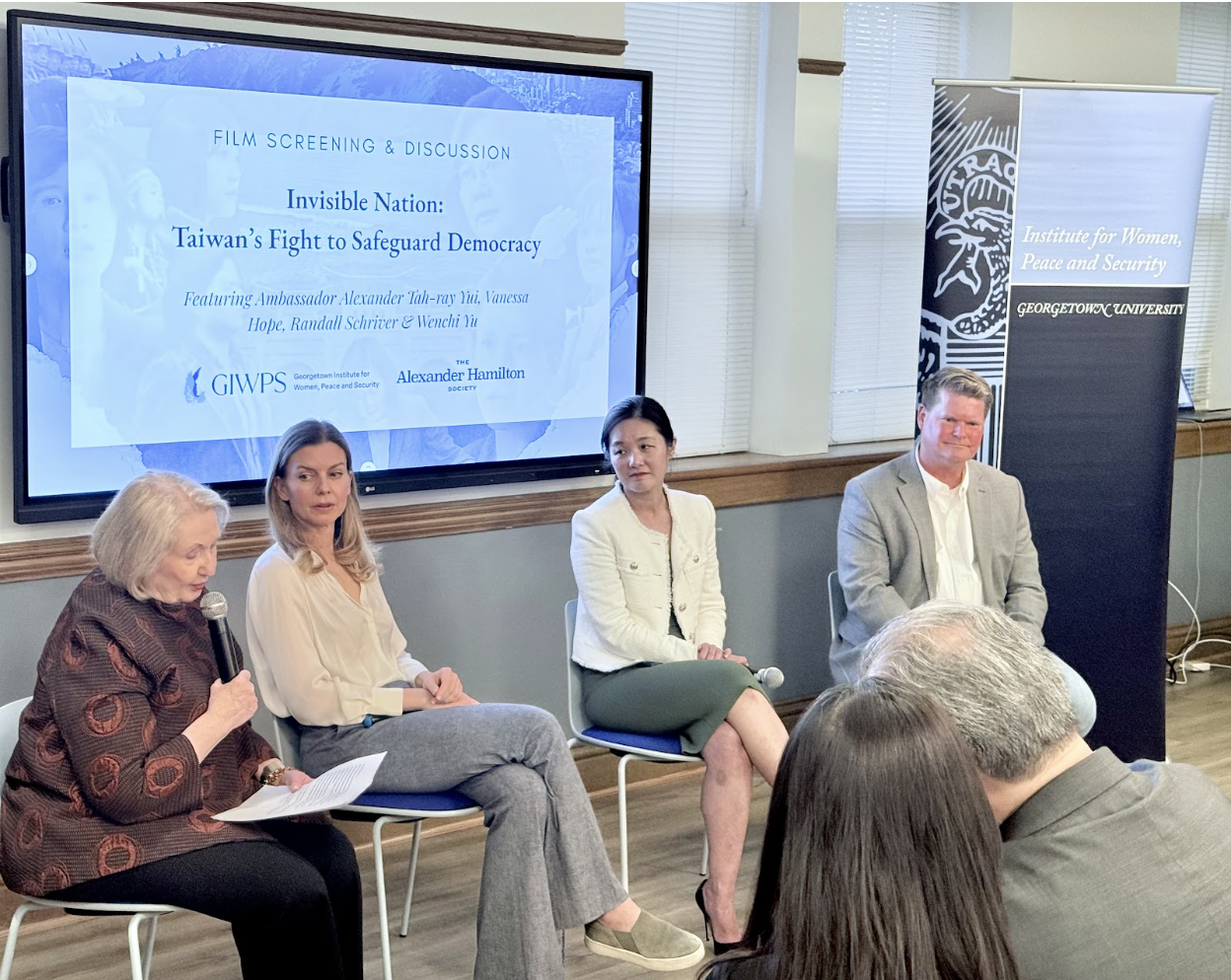
Film showing followed by a panel discussion with Melanne Verveer, Vanessa Hope, and Wenchi Yu at Georgetown University (Brittany McAlister, The Caravel).
GEORGETOWN UNIVERSITY (WASHINGTON, D.C.) — A screening of the documentary Invisible Nation at Georgetown University on March 31, 2026, drew a packed audience and sparked an urgent conversation about Taiwan’s political future, its democratic resilience, and the growing international stakes surrounding the island as tensions with China continue to rise.
Hosted by the Georgetown Institute for Women, Peace and Security and the Georgetown Alexander Hamilton Society, the event brought together scholars, former officials, students, and filmmaker Vanessa Hope for a wide‑ranging discussion that blended geopolitics, history, and personal reflection. The film, which follows former Taiwan President Tsai Ing‑wen through her two terms in office, served as a starting point for a deeper examination of Taiwan’s identity and the global forces shaping its future.
The discussion came at a time when Taiwan is increasingly central to international security concerns. The Council on Foreign Relations’ Global Conflict Tracker lists the “Confrontation over Taiwan” as one of the world’s most dangerous flashpoints. The Institute for the Study of War has warned that China is expanding military, political, and information pressure on the island. A Congressional Research Service brief notes that U.S. law requires Washington to maintain the capacity to resist force against Taiwan. And recent reporting from WWNO and Iowa Public Radio shows Beijing extending rare outreach to Taiwan’s opposition leaders, signaling shifting political dynamics.
Against that backdrop, the Georgetown event offered a rare, unfiltered look at how Taiwanese leaders and civil society are navigating a moment of global uncertainty and why the world should pay attention.
A Leader Who Didn’t Want the Spotlight
Hope told the audience that Tsai never wanted the film to center on her.
“President Tsai is not someone who wanted me to make a biographical film about her,” Hope said. “She told me, ‘Please interview other people in my administration, other people on the ground in Taiwan, and observe what’s happening. I am not the focus.’”
Hope said she was struck by Tsai’s humility and her leadership style.
“She’s very detail‑oriented,” Hope said. “As Michael Fonte says in the film, she doesn’t shame people after a high‑level meeting. She’ll take someone aside and give them pointers.”
Hope said she was also surprised by Tsai’s warmth.
“I had no idea how close she was with her staff or with her cats and her dogs and that they would become part of the film,” she said.
One moment Hope wished she could have included was Tsai’s historic apology to Taiwan’s Indigenous peoples.
“I wanted to include President Tsai’s apology, but the team felt it was such a big story with so many different Indigenous groups and perspectives that it deserved its own film,” she said. “Someone should make that film.”
Hope said the film’s global reception has exceeded anything she imagined.
“Events like this — screenings around the world, at over 50 film festivals and so many universities — exceed my wildest expectations,” she said.
A Taiwan Transformed
One panelist reflected on how much Taiwan has changed in a single generation.
“I left Taiwan in the year 2000, and Taiwan then was a very different place compared to now,” she said.
She said the film captured something many outside Taiwan rarely see: the strength of its civic movements.
“What I appreciated most from the film was how it documented the civil society movement in Taiwan,” she said. “You have very self‑motivated civil society groups — labor, women’s rights, anti–death penalty, environmental issues — and it’s an extremely vibrant civil society you usually only see in Western democracies.”
She added that Taiwan’s democratic institutions were built through sacrifice.
“So many people sacrificed their youth — even their lives — to create democratic institutions that allow civil society groups to participate, and allow citizens to participate,” she said.
This year marks the 30th anniversary of Taiwan’s first direct presidential election, a milestone that several speakers said is often overlooked abroad.
Identity and the Status Quo
Taiwan’s evolving identity was another major theme.
“During President Ma Ying‑jeou’s time, the exclusive Taiwanese identity surpassed the dual identity for the first time,” one panelist said. “But while more people identify as Taiwanese only, that doesn’t mean they feel Taiwan should declare independence — the cost would be so high.”
She added that if there were no consequences, the answer might be different.
“If you ask people privately if there were no costs [and] what they would choose, I think we know the answer,” she said.
For now, she said, most Taiwanese prefer stability.
“The consensus for maintaining the status quo has been around 85 to 90 percent,” she said. “The voices for outright independence or reunification are getting smaller. The middle is growing.”
A Region on Edge
The conversation also turned to global crises from Ukraine to Iran and how they shape Beijing’s calculations.
“We have to see how Iran unfolds and whether there is an exit, what that looks like, and whether some of this diversion of attention and resources is temporary or a real inflection point,” one expert said. “We don’t quite know yet.”
He said China is watching the world closely.
“From the Chinese perspective, there are still reasons for caution,” he said. “They were surprised, like many, at the difficulties Russia faced in Ukraine.”
He added that Taiwan’s geography makes it a formidable challenge.
“Taiwan is not an easy target,” he said. “It’s 89 miles of water, mountainous, inhospitable terrain, unplayable sea conditions for much of the year, and very few ports. This is tough even for an experienced military.”
He said China would prefer to avoid a war.
“China would rather win without fighting through coercion, intimidation, and pressure,” he said.
The Semiconductor Shield
Taiwan’s dominance in semiconductor manufacturing, often called the “Silicon Shield,” was another focus.
“For Taiwan’s position on the world stage, it probably offers some degree of security and safety from China,” one panelist said.
But he dismissed the idea that China could seize Taiwan to gain control of its chip industry.
“TSMC would stop being TSMC if the Chinese took it over,” he said. “They rely on U.S. design and global inputs. Taking Taiwan wouldn’t give China what it wants.”
He said Taiwan’s chip leadership is likely to endure.
“If we think reliance on Taiwan is a problem, getting out of that reliance is really hard,” he said. “TSMC will keep innovating and keep getting better. Its position is likely to remain for as far as we can see.”
A Divided but Vibrant Democracy
Panelists also discussed Taiwan’s domestic politics.
“Some say Taiwan’s domestic politics are heavily divided — maybe as divided as the U.S.,” one speaker said. “The ruling administration doesn’t have a legislative majority, which makes moving things forward difficult.”
She said Taiwan’s media landscape adds complexity.
“Taiwan has the highest number of media outlets per capita in the world,” she said. “It’s the freest press environment in Asia, but that also means misinformation, especially from China, is a major concern.”
She added that civic activism remains strong.
“There were major recall campaigns last year because people were unhappy with their legislators,” she said. “Taiwan has referendums and many tools citizens can use to challenge what they don’t like.”
Gender and Leadership
Taiwan’s progress on gender equality also drew attention.
“Taiwan’s female political participation rate is the highest in Asia — almost 50 percent of legislators are women,” one panelist said. “Many senior political leaders are women, but they don’t talk about it. They just do the work.”
She said Taiwan’s social policies reflect that leadership.
“If you go to Taiwan, you see nursing rooms everywhere,” she said. “Public spaces are very friendly to families and women. But it’s not touted as a political achievement. People just do what’s needed.”
A Call for Respect and Dialogue
During the Q&A, one attendee asked what message a U.S. president should send to Beijing during an upcoming visit.
Hope responded:
“I hope he has the ability to show respect for the President of Taiwan,” she said. “Part of the trouble is that Xi Jinping doesn’t want to meet with a leader of the Democratic Progressive Party or treat Taiwan as an equal.”
Another panelist said Taiwan should not fear being bargained away.
“I don’t think he has an interest in going and throwing Taiwan under the bus,” he said. “Taiwan always has to be a little nervous when China and the U.S. are talking, and you’re not in the room, but I feel confident Taiwan’s interests will be protected.”
A Closing Message
As the event ended, the moderator thanked the panelists and urged the audience to keep learning.
“You can tell everybody you watched Invisible Nation,” she said. “And visit InvisibleNation.net. Before the PBS broadcast, you can host a living‑room screening.”
Hope added that the film’s impact depends on people continuing the conversation.
“I want to encourage more people, especially Taiwanese people, to make more films about Taiwan,” she said. “There are so many stories still to tell.”