Protesters Rally at White House as Iran’s Unrest Deepens and Fears of Wider Conflict Grow
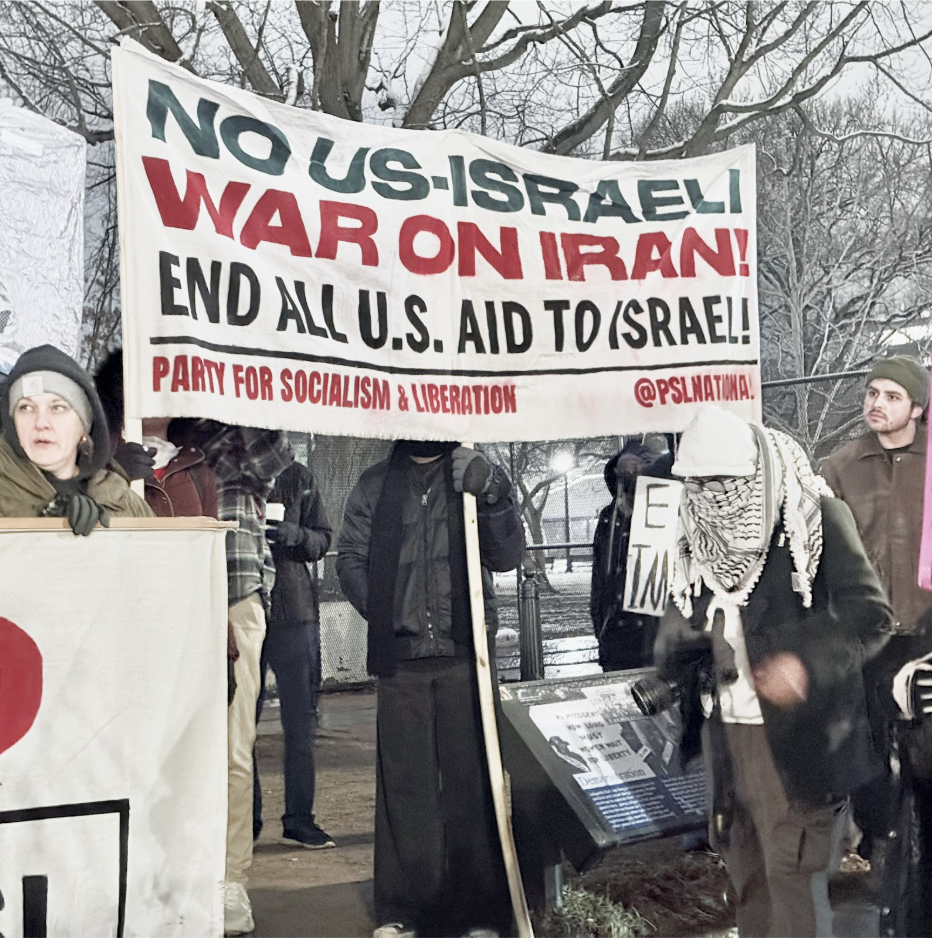
Protesters demonstrate outside the White House on March 2, 2026 to deliver a stark global warning following the United States and Israel’s recent strike on Iran (Brittany McAlister).
WASHINGTON, D.C. — Hundreds gathered outside the White House on Monday night as Iran’s sweeping unrest entered its third month, with demonstrators warning that U.S. policy risks worsening a crisis already marked by mass arrests, internet shutdowns, and deadly force against civilians. The protest came as Georgetown University urged students in the Middle East to take precautions amid rising regional tensions.
The rally, organized by a coalition of anti‑war and community groups, drew students, activists, and former government employees who said the United States must avoid actions that could inflame an already volatile situation. Their concerns reflect a moment when Iran’s domestic turmoil and long‑standing geopolitical rivalries are colliding in ways that many fear could spill beyond the country’s borders.
Iran has been engulfed in unrest since late December, when soaring inflation, food shortages, and a collapsing currency triggered demonstrations across the country. What began as economic frustration quickly turned into political demands, with protesters calling for accountability from a government they say has failed to address corruption and economic collapse. Security forces have responded with live ammunition, mass detentions, and sweeping internet blackouts, according to human rights groups.
Some demonstrators in Washington said they believed U.S. actions were contributing to instability. Albert Chu, one of the protesters, said he viewed American policy as part of a long pattern of interference in Iran’s internal affairs.
“The United States has been doing nothing but continuing endless hostilities, aggression, and attacks on Iran,” Chu said. “They need to put an end to all this aggression against sovereign nations.”
Chu’s comments reflect a broader sentiment among some activists who see Iran’s unrest not only as a domestic crisis but as a flashpoint in a decades‑long struggle between Washington and Tehran.
The protest came one day after Georgetown University Interim President Robert M. Groves sent a message to students, faculty, and staff addressing developments in the Middle East. In the email, Groves said the university was monitoring the situation closely and coordinating with Georgetown University in Qatar (GU‑Q) as regional airspace closures and security concerns disrupted travel.
“Our MBA Global Experience program was scheduled to start today, March 1, in Dubai,” Groves wrote. “We have suspended this course and are working to bring students back home as soon as possible.”
Groves said the safety of Georgetown community members “around the world is our top priority,” noting that the GU‑Q website would continue to provide updates on regional security and university operations.
The message showed how unrest in Iran and fears of broader instability have begun to affect institutions far beyond the country’s borders.
Iran’s current turmoil is the latest chapter in a long history of political upheaval and confrontation with foreign powers. The 1979 revolution overthrew the U.S.-backed Shah and established the Islamic Republic, setting the stage for decades of tension with Washington. The two countries have clashed over nuclear ambitions, sanctions, proxy conflicts, and regional influence.
Iran has also faced repeated waves of domestic protest, including the 2009 Green Movement, the 2019 fuel price demonstrations, and the 2022 uprising following the death of Mahsa Amini. Each movement has been met with force, but analysts say the current unrest is among the most severe, fueled by economic collapse and frustration with political stagnation.
The scale of the crackdown has raised alarms among international observers who warn that Iran’s internal crisis could spill into neighboring countries, especially as regional powers navigate shifting alliances and security threats.
For many at Monday’s protest, the fear is not only that Iran’s government will intensify its repression, but that U.S. actions could further destabilize the region.
Kashaf Jabbar, a student who attended the rally, said she believed many Iranians want political change but reject foreign involvement.
“The Iranian people definitely wanted their regime change, yes, but they wanted it on their own terms,” Jabbar said. “They don’t want it for American interests or Western interests.”
Jabbar said she joined the protest because she sees a pattern of governments “getting more and more audacious” in targeting civilians, pointing to conflicts in Gaza and elsewhere. As a Muslim, she said she feels a personal connection to those suffering abroad.
“These movements are going to get more and more unpopular,” she said. “People are going to keep coming out.”
Others at the protest said they were motivated by firsthand experience with U.S. foreign policy. Deanna Gordon, a retired Foreign Service officer, said she attended because she believes Washington risks repeating past mistakes.
“It’s disheartening to keep coming out, but I feel like we have to,” Gordon said. “People are going to get killed. We need a critical mass.”
Gordon said she worries that U.S. actions could harden Iran’s leadership rather than support Iranians pushing for change. “I don’t see any way it could not get worse,” she said.
The Trump administration has said it supports the rights of Iranian protesters and has imposed sanctions on officials involved in the crackdown. But critics at Monday’s protest argued that sanctions and military pressure only deepen the suffering of ordinary Iranians.
As the protest ended, organizers urged attendees to remain engaged as Iran’s crisis unfolds. Many said they plan to continue pressuring U.S. officials to avoid actions that could inflame tensions.
“We want our leaders to stand up and take responsibility,” Gordon said. “We are not going to stop fighting.”
For Georgetown students, the university’s message served as a reminder that events unfolding thousands of miles away can have immediate consequences at home and that the situation remains fluid.
Groves said the university would “continue to closely monitor this evolving situation.”