
Nine Femicides in South Africa Further Debate over Gender-Based Violence
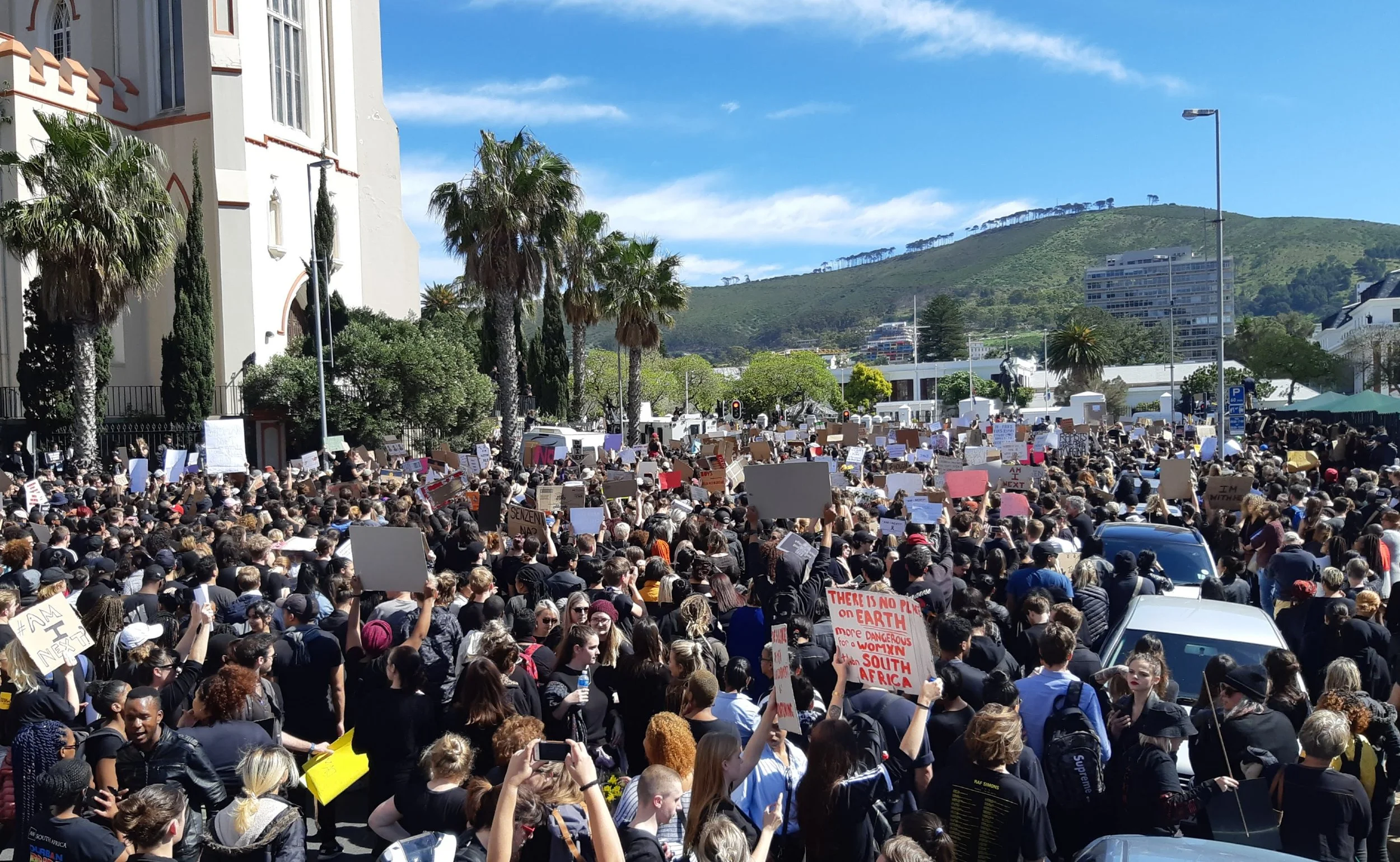
Thousands of protesters gather in Cape Town after the 2019 murder of a South African woman (Discott).

A South African woman’s body was found dead in Ekurhuleni on September 17, marking the ninth such instance in the past two months in the municipality just east of Johannesburg. The known victims include Dineo Motapane, 38, Gracious Nkomo, 28, Elizabeth Moselakgomo, 38, and Itumeleng Kekana, 32, while five other victims remained unidentified. The South African Police Service (SAPS) is investigating whether the killings are connected, as well as the possibility that a serial killer is responsible. The mere potential that so many murders in such a limited time and place could be unrelated exposes a larger issue in South Africa: that gender-based violence and femicide (GBVF) is not an isolated crisis but a long-standing national reality.
South Africa has one of the highest recorded rates of femicide in the world. A 2022 study from Our World in Data calculated that 12.2 per 100,000 women are victims of femicide, a rate nearly five times the global average. Amnesty International estimates that approximately 155,062 crimes were committed against women and 2,655 women were murdered between 2020 and 2021. SAPS reported over 50,000 GBVF in 2025 alone. The scale of violence is so severe that the South African government formally classified GBVF as a national disaster last year.
Historically, gender-based violence in South Africa has been entrenched in the colonial and apartheid eras. Apartheid, which lasted from 1948 until the democratic transition of the early 1990s, created a system of racial and economic domination that profoundly shaped gender relations and notions of power in South Africa. Apartheid stripped Black South Africans of their basic rights and freedoms, which led them to seek forms of authority within the home, scholars have argued. The apartheid system also influenced the way sexual violence was understood in South Africa, as it became a legitimate form of imposing gender rankings and power. Thus, apartheid’s racialized and patriarchal systems contributed to patterns of violence that remain today.
The problem's generational persistence has prompted repeated government responses. In 2019, following the Presidential Summit on Gender-Based Violence, South Africa began developing a National Strategic Plan on Gender-Based Violence and Femicide. The plan established six pillars focused on accountability, prevention, justice and protection, support for survivors, economic empowerment, and research—all aimed at creating a long-term response to GBVF rather than simply addressing isolated cases. Yet its implementation has also faced delays due to miscoordination and insufficient resources. In 2025, the government launched a 90-day acceleration program specifically designed to fast-track the plan’s implementation.
The nine cases show that these measures have been ineffective in improving women's safety and security. SAPS has issued warnings urging women in the region to avoid going out alone, be cautious in isolated spaces, and share their location with loved ones. However, this largely shifts the responsibility for preventing violence onto women themselves, rather than addressing the root of the violence. Amnesty International’s South Africa Director Shenilla Mohamed says that “Women are tired of platitudes. We want to know what is going to be done to make women and children feel safe.”
Frustration over government inaction has compelled many South Africans to turn to activism. After Moselakgomo was reported missing while on a run, community members organized memorial 5k and 10k events in her honor. Last year, Women For Change, a prominent non-profit in South Africa, launched the Purple Movement, which encouraged over 700,000 people to change their social-media profile pictures to purple in a digital protest against GBVF. The campaign grew into the G20 Women's Shutdown on November 21, when hundreds of thousands of people participated in coordinated protests in South Africa and across the globe to demand that GBVF be classified as a national disaster—and, shortly after the protest, it was.
The nine women found dead in Ekurhuleni have reopened a much larger conversation about GBVF in South Africa. They represent an extended history shaped by the long-lasting legacy of apartheid, which continues to influence personal and social power dynamics while fueling the ever-growing movement of women demanding that safety become more than just a warning to “be careful.”