
Georgetown Lecture Examines Historical Roots of Authoritarianism in Muslim Societies
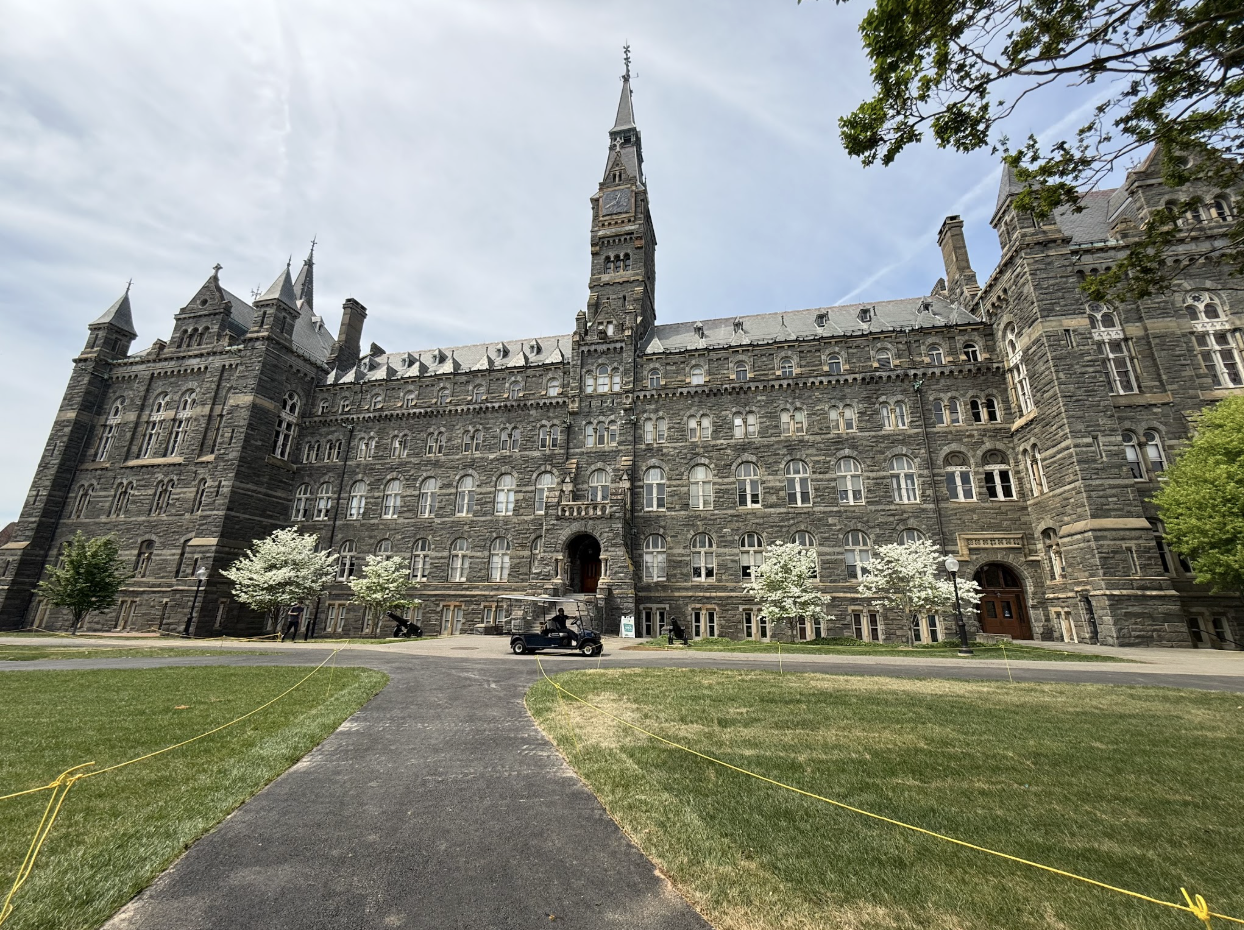
Healy Hall at Georgetown University (Brittany McAlister, The Caravel)
WASHINGTON, D.C. (GEORGETOWN) — Last month, Georgetown University’s Alwaleed Center for Muslim‑Christian Understanding (ACMCU) hosted San Diego State University professor Ahmet Kuru on March 31 for a wide‑ranging lecture on the historical evolution of political authority, intellectual decline, and class relations in Muslim‑majority societies. The event, held over Zoom, drew students, faculty, and researchers from across the university.
The session opened with an extensive introduction from the Georgetown host, who described Kuru’s most recent book, Islam, Authoritarianism, and Underdevelopment, as “a major intellectual achievement.” The host highlighted the book’s international recognition, noting that it had been listed by the Times Literary Supplement as one of the most important books of the year and had received multiple awards. “This book has also been translated into 16 languages,” he said.
Kuru began by situating the book within his broader intellectual journey. “The main argument [was] already elaborated in the last seven years,” he said, explaining that the book had sparked debates across regions, from academic discussions in the West to public controversies in the Middle East. In some countries, he noted, “there was a discussion whether [to] ban the book.”
He recounted how the book’s reception varied widely. In Indonesia, he said, audiences were “so nice” and intellectually receptive, while in Malaysia he faced an online campaign labeling him “a liberal,” a term he explained was used to imply he was “a kafir or an anti‑Muslim person.” The scale of the reaction surprised him: “Thousands of comments liked this campaign.” After receiving death threats, he contacted the U.S. Embassy, which told him, “You have to leave immediately this country.”
Despite the challenges, Kuru said the experience created unexpected opportunities. Indonesian colleagues encouraged him to publish an article in Kompas, the country’s leading newspaper, contrasting Indonesia’s reception of his work with Malaysia’s. “They said, 'Why don’t you write an article saying why Indonesia welcomed me, [and] Malaysia did not,’” he explained.
Kuru also described difficulties in Central Asia, particularly Uzbekistan, where the translation of his book faced institutional barriers. “They say you have to get permission for the Ulamakos,” he said. “And Ulamakos is not giving us the permission.” He noted the irony of being blocked by religious authorities despite writing a political science book: “I am not a theologian. I am a social scientist.”
Transitioning to the substance of his argument, Kuru acknowledged that some listeners might question the timing of his critique. “Your inner voice may say, at the time of a genocide in Gaza, American bombing, Israeli attack to Iran, this scholar comes to ask Muslims [to] have a self‑critique,” he said. But he argued that internal analysis remains essential: “Today is a time really to look at the internal functions.”
Kuru framed his book around a central question: why Muslim‑majority societies, once intellectually and militarily powerful, now lag behind global averages in development and democracy. He pointed to recent events in Iran as an example of contemporary vulnerability, referencing the deaths of “between 7,000 to 25,000” people in a recent incident. “This shows that we have a problem,” he said.
He then turned to the historical foundations of his argument. “After the 11th century, there was a reverse of class relations,” he said. “Europe started to diversify social classes [and] establish a viable economy. [The] Muslim world started to have a unified religion of political power that undermined both commercial and intellectual classes.”
Kuru emphasized that earlier Islamic history featured strong traditions of scholarly independence. “There was strong emphasis on independence,” he said, citing figures such as Abu Hanifa, al‑Khwarizmi, al‑Razi, Ibn al‑Haytham, and al‑Biruni. He highlighted data showing that among 3,900 scholars between the 8th and 11th centuries, “only nine accepted public positions,” while “91% had a very long list of alternative private jobs.”
According to Kuru, this independence eroded due to economic crises, political centralization, and the rise of military elites. He described how the Seljuks introduced a “militarized mentality,” and how thinkers like Mawardi articulated doctrines that strengthened centralized authority. These developments, he argued, created a “critical juncture” that set Muslim societies on a long‑term path of authoritarianism.
Kuru also addressed the role of technology, particularly printing. He noted that while Europe rapidly adopted printing after 1450, “Muslims waited 284 years to have a single printing press.” He argued that this delay had profound consequences: “Can you imagine a society without the internet for 284 years?”
Turning to the modern period, Kuru argued that the ulema–state alliance continues to shape political outcomes. He explained that he deliberately uses the term “Ulema‑state alliance” rather than “state‑Ulema alliance” because, historically, “it’s the Ulema like the state.” He described the relationship as a partnership: “I don’t want to say 51 percent or 49 percent — two partners.”
He explained why the alliance remains powerful: “The government can put me in jail. The government can dispossess me. But the government cannot declare me an infidel.” In many Muslim‑majority societies, he said, “the worst thing… is to be declared apostate, and it has the power of the Ulema.” This religious legitimacy, he argued, makes authoritarian regimes “very strong and robust.”
Kuru also addressed misconceptions about Islamic history. He rejected claims that Islam inherently rejects the separation of religion and state. “At the time of the Prophet, there was no institutional state,” he said. “He was the last one receiving revelation; therefore, he’s a unique model, not to be repeated.” He argued that for centuries, Muslim societies practiced forms of separation: “There is no religious text basis” for the claim that Islam mandates fusion of religion and state.
During the Q&A, Kuru responded to questions about solutions. He argued that the key is “separation of spheres,” not hostility to religion. He warned that assertive secularism — such as banning religious symbols — “will not bring democracy.” Instead, he advocated for autonomy across domains: “Every sphere of life should be autonomous, to avoid corruption.”
Kuru closed by emphasizing that his argument is not pessimistic. He said he hopes Muslim societies can draw on their own history of “coexistence, dynamism, and creativity.” The host concluded by praising the book as “an incredibly rich, important” contribution to debates on religion and politics.