
Renewed Fighting Deepens Lebanon’s Humanitarian Crisis as Georgetown Event Probes Why Some Conflicts Get More Attention
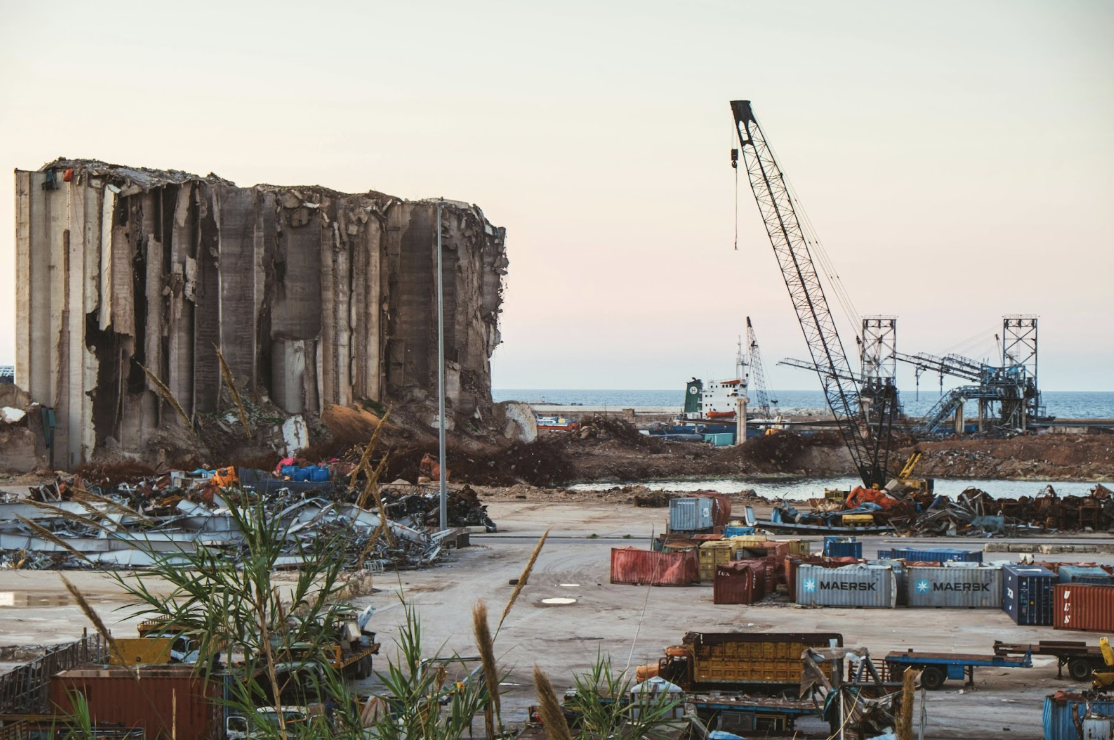
Photo of Beirut in the aftermath of protracted conflict (Jo Kassis).
Escalating cross‑border fire between Israel and Hezbollah has displaced tens of thousands of people in southern Lebanon, compounding a humanitarian emergency in a country already strained by economic collapse and the world’s highest per‑capita refugee population. As the crisis worsens, a Georgetown University event last week examined how Americans interpret conflicts in the Middle East — and why some crises, like Lebanon’s, remain largely overlooked.
The discussion, held virtually on a Zoom conference call, featured author and critic Adam Kirsch. Speaking to students, faculty and community members, Kirsch explored the growing influence of “settler colonialism” as a framework for understanding global conflicts. Although the event focused primarily on Israel and Zionism, the conversation offered a timely lens for understanding why Lebanon’s humanitarian crisis has struggled to break through in U.S. discourse.
“Settler colonialism is really a political theory of original sin,” Kirsch said. “It says that countries that began as settler‑colonial enterprises are permanently tainted by that.”
His remarks came as humanitarian organizations warn that Lebanon is entering one of its most precarious periods in years. According to local officials and aid groups, more than 90,000 people have been displaced from southern towns such as Aitaroun, Bint Jbeil and Marjayoun since fighting intensified in October. Families have fled north with little warning, often leaving behind homes, farmland and livestock.
Municipal leaders say the country is ill‑equipped to absorb another wave of displacement. Schools have been converted into shelters, hospitals report critical fuel shortages and many clinics in the south have closed due to insecurity. Lebanon also hosts more than 1.5 million Syrian refugees, many living in informal settlements with limited access to food, clean water or medical care.
The International Rescue Committee placed Lebanon on its Emergency Watchlist, warning that the country faces “a rapidly deteriorating humanitarian situation driven by conflict, economic collapse and political paralysis.” The report noted that renewed fighting in the south has “exacerbated already severe vulnerabilities,” leaving both Lebanese citizens and refugees at heightened risk.
Despite these conditions, Lebanon has received far less international attention than neighboring conflicts. That disparity, Kirsch suggested, may be tied to the frameworks shaping how Americans — especially younger generations — interpret events in the region.
“It’s a way of diagnosing or explaining everything that could conceivably be wrong about a society,” he said of settler‑colonial theory. “Things that are wrong about American society can be traced back to settler colonialism.”
Kirsch argued that the framework has become a dominant interpretive tool in academic and activist spaces, particularly on U.S. campuses. Conflicts that fit the model — such as Israel‑Palestine — tend to dominate public debate. Those that do not, like Lebanon’s multi‑layered crisis, often struggle to gain visibility.
The conversation also touched on the historical forces that shaped the modern Middle East. Kirsch noted that the region’s borders were drawn by European powers after World War I, creating political structures that continue to influence today’s conflicts. “The entire map of the modern Middle East is in large part a legacy of British and French imperialism,” he said.
Lebanon’s displacement patterns reflect that legacy. Palestinian refugees have lived in the country since 1948, when the first Arab‑Israeli war uprooted hundreds of thousands. Syrian refugees arrived decades later, fleeing a civil war shaped by authoritarian rule and regional intervention. Now, Lebanese civilians are being displaced by cross‑border fire tied to unresolved regional rivalries.
Kirsch cautioned, however, that applying settler‑colonial theory too broadly can flatten the complexity of Middle Eastern conflicts. “Thinking about Israel as a settler‑colonial project obscures more than it reveals,” he said. “Jews and Jewish history do not fit paradigms that were evolved for other, much bigger groups.”
He warned that the framework can encourage observers to view conflicts as simple binaries — colonizer versus colonized — rather than as multi‑layered struggles shaped by local histories, political actors and competing national narratives. In the Israeli‑Palestinian context, he said, this framing “casts the conflict in zero‑sum terms” and undermines possibilities for compromise.
Applied to Lebanon, a 2021 report by the World Bank as well as a 2023 report by IEMed suggested that such binaries risk reinforcing misconceptions that the country’s crises stem solely from external forces, rather than from a combination of colonial legacies and internal political failures. Lebanon’s current emergency is driven not only by regional conflict, but also by years of economic mismanagement, political paralysis and the collapse of state institutions.
Humanitarian organizations are urging the international community to increase support as conditions deteriorate. The World Food Programme (WFP) reported in 2024 that half of Lebanon’s population now struggles to afford basic food. The Lebanese Red Cross says medical needs are rising in the south, where many clinics have closed and ambulances face delays due to ongoing shelling.
For displaced families, the crisis is immediate and personal. Homes have been lost. Income has disappeared. Many do not know when, or whether, they will be able to return.
Kirsch told the Georgetown audience that long‑running conflicts often evolve in ways that are difficult to predict. “Things can happen over time that don’t seem possible at a given moment,” he said.
For Lebanon, the question is whether the world will pay attention before the crisis deepens further — or whether it will remain overshadowed by conflicts that fit more neatly into the narratives dominating American debate.