
Vance’s Visit to Armenia and Azerbaijan Signals Shifting Power Balance
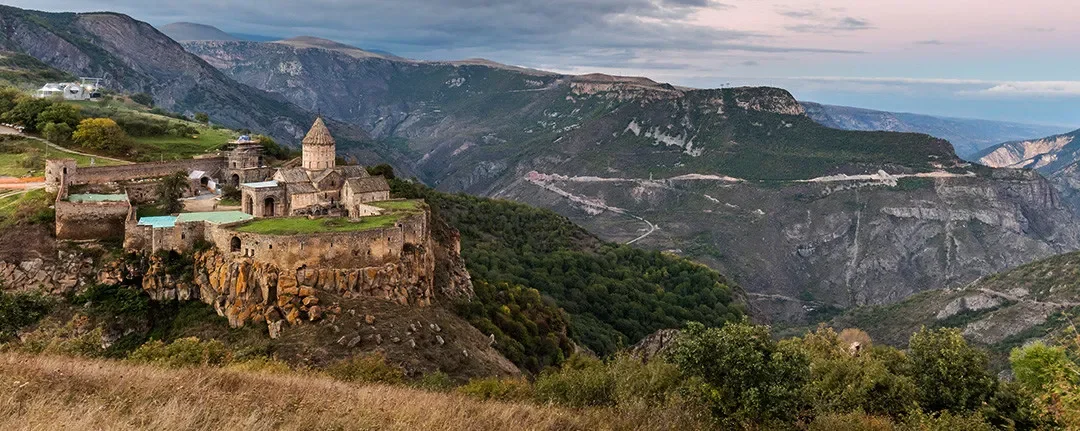
Part of the visit’s goals was promoting the Trump Route for International Peace and Prosperity, an U.S.-led infrastructure initiative (Diego Delso).
U.S. Vice President JD Vance visited Armenia and Azerbaijan during his tour of the Caucasus on February 9, according to the Council on Foreign Affairs. The visit culminated in an agreement for the United States to license nuclear technology and equipment to Armenia, according to Responsible Statecraft. Leaders also signed other agreements to sell U.S. defense systems and allow licensing for graphics processing units in connection with an AI supercomputer project. In Azerbaijan, Vance and President Ilham Aliyev signed a charter on economic investment, regional connectivity, and national security and defense.
This was the first visit by a U.S. Vice President to Armenia, intended to “advance President Donald Trump’s peace efforts” in Armenia and Azerbaijan following the countries’ trilateral summit in August, according to Le Monde. Vance’s visits reflect good standing with both countries, while bilateral agreements, such as those signed on this trip, promote trust in the United States, as the country has positioned itself as a key mediator of Armenian-Azerbaijani tensions.
Key to this visit is also the U.S. promotion of the Trump Route for International Peace and Prosperity (TRIPP), an infrastructure initiative announced at the August summit intended to foster interconnectivity. It would link Central Asia to the Caspian region by becoming part of the vital transportation route known as the Middle Corridor. Primarily, it would connect Azerbaijan to Turkey through Southern Armenia, which requires cooperation between these historic enemies. While the corridor aims to foster peace between Yerevan and Baku and support “Armenia’s long-term economic growth, connectivity, and regional integration,” the United States will hold a 74% controlling stake, relative to Armenia’s 26%, in the corridor after the initial 49-year construction period. This highlights that the United States also has a strategic and economic interest in promoting peace and integration efforts, in addition to maintaining beneficial relationships with the countries.
Furthermore, this plays into another motive: the U.S.’s efforts act as a symbolic move against Russia. The South Caucuses are historically regarded as Russia’s area of influence, but Vance’s visit signifies a shifting balance of power in the region. TRIPP will prove a vital alternative corridor for energy flows across Eurasia that were previously exclusive to Russia and Iran. A Russian columnist for state-controlled newspaper Kommersant writes, “It is precisely in this region… that Russia’s position has noticeably sunk in recent years.” Vance’s visit signals a shift from the way previous administrations approached the South Caucasus—placing importance on “peace through construction,” emphasizing economic relationships with the countries, and attaching identity to countries formerly viewed as Russia’s backyard, according to the Carnegie Endowment for International Peace. Moreover, it sends a message that the United States is not afraid to venture into traditionally Russian areas, according to the Center for European Policy Analysis.
Though Washington does not seek to establish a military presence on Russia’s doorstep through these deals, the growing U.S. economic presence in this particular area makes a statement that, as Russia’s power in the South Caucasus weakens, U.S. influence magnifies.