
Gen-Z Protests in Madagascar Force Out Its President
Protesters in Madagascar strike chords worldwide | Pexels
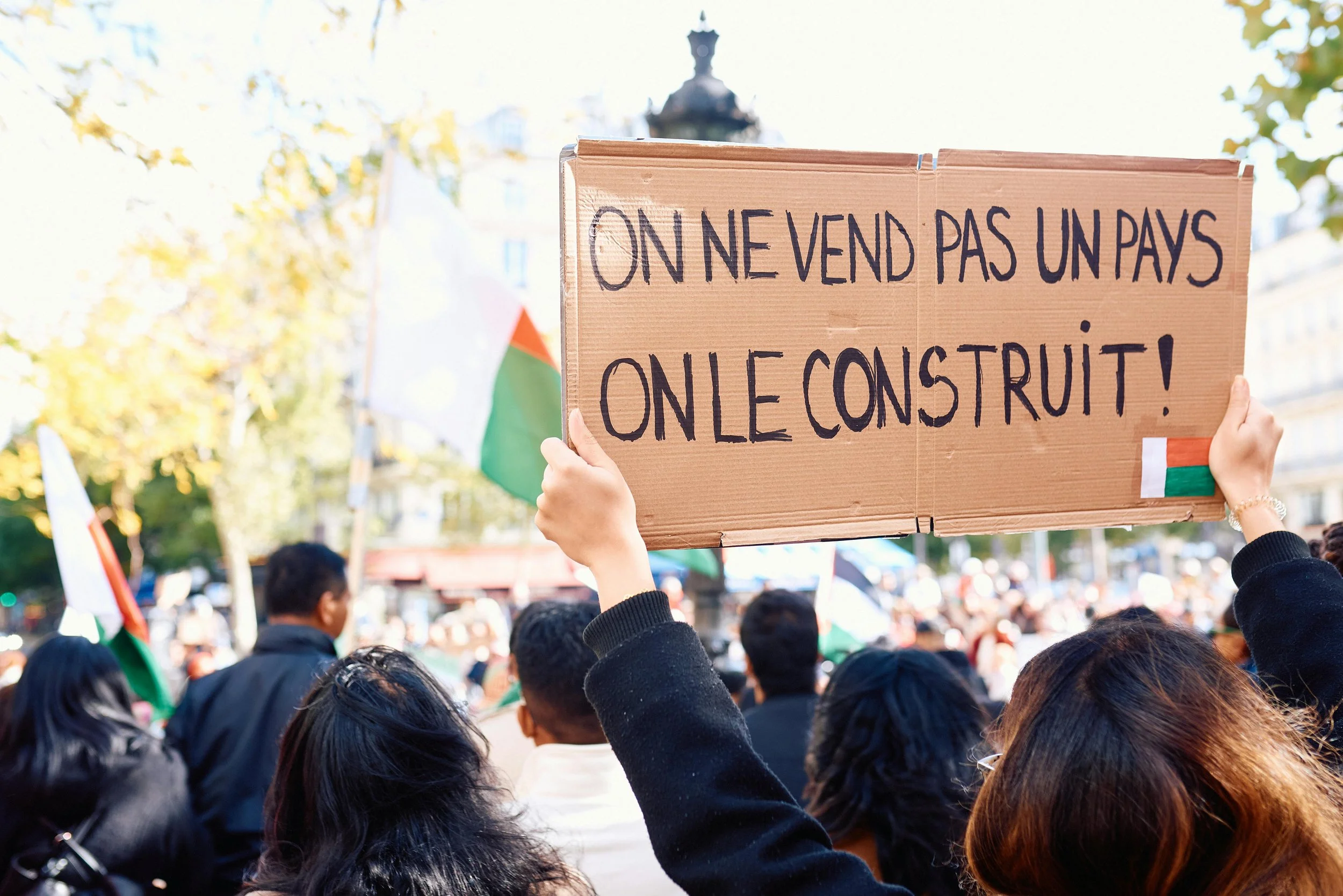
Andry Rajoelina, the president of Madagascar, fled the country between October 11 and 12 after youth-led demonstrations against corruption and high costs of living escalated into a full-blown military coup. Students, who had been protesting for weeks, finally forced Rajoelina to leave office after they were joined in recent days by CAPSAT, the country’s elite military unit. CAPSAT’s commander, Michael Randrianirina, has now become Madagascar’s new (unelected) interim leader. Intent on proving his legitimacy, he has promised elections within two years and appointed a civilian Prime Minister, businessman Herintsalama Rajaonarivelo. However, this selection has already caught heat for its “non-transparent” nature and because of Rajaonarivelo’s “connection to the previous government.”
Randrianirina also has his work cut out for him in reviving his country’s growth. Madagascar’s economy has been contracting for decades, in ways both large and small. Both GDP per person and the quantity of paved roads in Madagascar have roughly halved since 1960. Deforestation has wrecked the country’s soil, and Madagascar faces high interest rates and a ballooning trade deficit. Furthermore, everyday Malagasy were subject to frequent power and water shortages, which ultimately provided the impetus for the first demonstrations that eventually brought down Rajoelina. Over time, the initial marches morphed into a general denouncement of the government’s inability to address these problems.
Young Malagasy in particular feel unrepresented. They formed the bulk of protesters, and remain highly motivated, coordinating on social media in groups like Tonga Saina, which has 18,000 members on Facebook. The role of Gen-Z in Rajoelina’s ousting is a continuation of a worldwide trend of leadership changes caused by youth protests, with three South Asian governments being forced out of office in the past four years, including Nepal, whose president resigned a month ago. Peru’s president also faced weeks of student-led marches before the Peruvian Congress unanimously impeached her on October 10. Young Malagasy have obviously taken inspiration from these events; many wore modified forms of a skull-and-crossbones cartoon used in Nepal’s protests as a symbol against authoritarianism and gerontocracy.
Along with economic concerns, the other main complaint against the government revolved around corruption. Among various other scandals, including election fraud, Rajoelina weathered controversy in 2023 when leaked documents revealed that he obtained French naturalization in 2014, in violation of Malagasy law, which prohibits citizens from holding dual nationalities. Accordingly, the new government has immediately stripped Rajoelina of his Malagasy citizenship. This scandal proved especially damaging because of its French involvement. France remains deeply unpopular across its former African colonies, including Madagascar. Compared to Britain and other past colonizers, France’s presence has lingered far more plainly. For instance, France owns military bases in many of these countries, which have been used to carry out UN peacekeeping missions, fight jihadists, and protect certain regimes. However, this system has come under fire recently. Many young Africans accuse France of engaging in “paternalism” and “neo-colonialism,” and want it to stop meddling in their countries’ affairs. Therefore, it should come as no surprise that Madagascar is not the only African country to recently experience significant regime change; since 2020, seven sub-Saharan nations have overthrown their leaders—all but one, Sudan, are former French colonies. However, contrary to the Malagasy protests, most of these coups were directly organized by high-ranking military leaders, whose radical anti-Western rhetorics are worryingly popular among the people; junta leaders commonly portray coups as efforts to get the French out while currying favor with Russia and China through opportune resource deals. Even still-democratic countries like Senegal and the Ivory Coast have forced France to withdraw their troops from the region in an attempt to appease anti-French sentiment.
Rajoelina’s ousting therefore represents a confluence of three trends: Gen-Z embracing its political clout, a spate of recent military coups, and Africa’s growing dislike of French interference. Given these factors, Rajoelina will probably not be the last African leader to suffer his fate, even if he still maintains that he is the legitimate president of Madagascar. Having first taken control in 2009 with his own popular coup, also backed by CAPSAT, Rajoelina reportedly escaped from the country in a plane sent by the French. So today he shelters in a “safe place,” aided by one loathed country, jettisoned by those groups who brought him to power 16 years ago. If Randrianirina wishes to become a dictator-for-life, as so many “coup belt” leaders do, he should focus on Rajoelina not as a threat, but as a learning lesson: he must now respect the Gen-Z activists who aided his rise of power, for fear of following in Rajoelina’s footsteps.