
Former South Korean President Yoon Suk Yeol Sentenced to Life in Prison
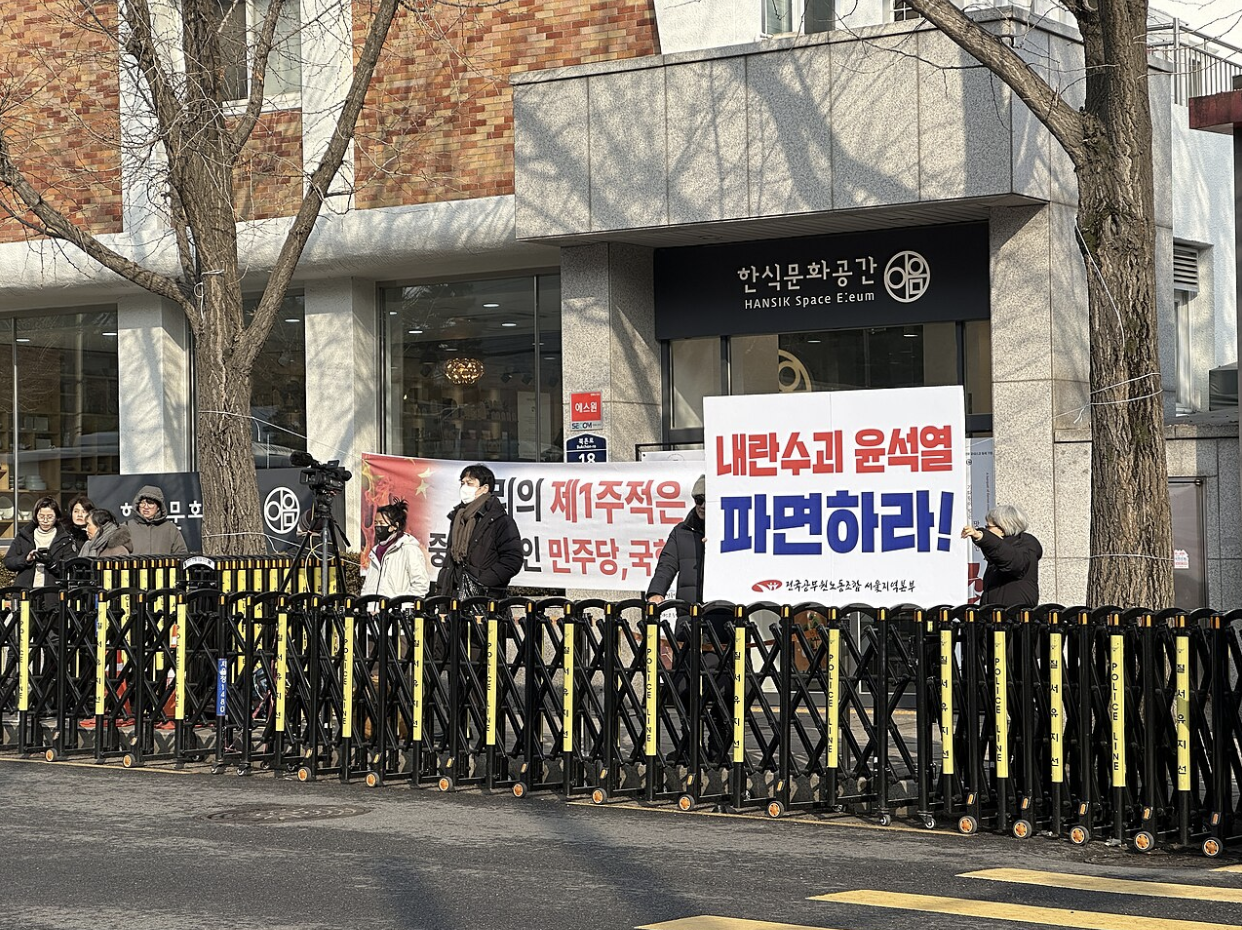
January 2025 protests near the constitutional court the day before Yoon Suk Yeol was arrested (seefooddiet).

A Seoul district court announced on January 19 that former South Korean president Yoon Suk Yeol received a life sentence for his attempted imposition of martial law a year ago. The harsh verdict reflects the life term given to Chun-doo Hwan, South Korea’s last dictator, who also enacted martial law in 1980.
On December 3, 2024, Yoon issued a sweeping measure permitting arrests without warrants and government takeover of media, citing the “anti-state” behavior of liberal forces who controlled nearly two-thirds of the national legislature. It took just three hours for 190 lawmakers to unanimously vote the decree down, despite the efforts of the military to block access into Parliament.
Eleven days later, 204 representatives voted to impeach Yoon, who was immediately suspended from office and formally removed by the Constitutional Court in April. 85 members of Yoon’s right-wing People Power Party (PPP) voted against his impeachment, while only a dozen or so were in favor.
Since the impeachment, the PPP has split into pro- and anti-Yoon factions, with the former holding the upper hand. The party’s leader at the time, Han Dong-hoon, was one of the 190 who nullified the decree of martial law; the PPP has since ejected him from the party and replaced him with defenders of Yoon’s actions. A majority of its lawmakers are stuck clinging to an unpopular position that has seen the PPP’s support plunge from 40 percent in the 2025 general election to under 25 percent now.
The situation in South Korea has many similarities to recent events in Brazil, where former right-wing president Jair Bolsonaro was sentenced to 27 years in jail in September 2025 for an attempted coup following his loss in the 2022 presidential election. As in Korea, the right-wing opposition seems to have internally split while attempting to back its fallen leader. It took Bolsonaro’s Liberal Party (PL) until December 2025 to coalesce around a nominee for this year’s election, as party leaders alternated between infighting and assuring themselves that Bolsonaro would run despite an eight-year ban from holding elected office. In the end, they duly selected Bolsonaro’s son Flavio, after Bolsonaro finally gave his endorsement from prison.
Bolsonaro’s children, however, have so far mainly been liabilities for the PL. In March, his son Eduardo moved to Texas to lobby the U.S. government for help on behalf of his father; President Donald Trump later placed 50 percent tariffs on Brazilian exports and dismissed the case against Bolsonaro as a “witch-hunt.” However, Brazil’s current leftist president, Luiz Inacio Lula da Silva (“Lula”), used this opportunity to salvage his poor approval ratings, rallying citizens around Brazilian sovereignty and anti-Trump sentiment. An attempted coup by a party leader and his son’s subsequent appeal to an adversary for aid seem to violate basic conservative values— respectively, the rule of law and nationalism. Yet the opposition-controlled Senate remains focused on Bolsonaro’s plight, having just two months ago approved a bill to shorten his sentence— promptly vetoed by Lula.
Amid an era of falling global trust in institutions, both Yoon and Bolsonaro claim unfair treatment from the courts. Yoon skipped multiple court sessions, and in his statement expressed “deep skepticism whether it would be meaningful to continue a legal battle through an appeal,” since “the independence of the judiciary cannot be guaranteed and a verdict based on law and conscience is difficult to expect.” The Constitutional Court voted unanimously, 8-0, to remove him from office, an outcome that Yoon’s lawyers called “pre-determined.”
Additionally, Brazil’s Supreme Court (STF) is unusually powerful, with a single judge alone capable of making decisions that in most countries are reserved for legislatures. Individual judges, most notably Alexandre de Moraes, have garnered massive public attention in this generally uncelebrated role. Elon Musk referred to Moraes as Darth Vader after de Moraes suspended X for a month in 2024, and he was even singled out to be sanctioned as part of Trump’s imposition of tariffs on Brazil in July. The PL’s claim of a politicized court can ring true; his rulings often appear, if not partisan, at least deeply personal. The implication of multiple STF judges in a recent corruption scandal involving the collapse of a bank with connections to Moraes’s wife furthers these allegations.
But conservatives have not been the only ones complaining about judicial decisions. Even though South Korea has not executed anyone since 1997, some leftists expressed dismay that Yoon wasn’t sentenced to death for his actions. South Korea has a long history of treating its former rulers very leniently; Chun received a presidential pardon after serving just two years of his life sentence. In Brazil, Bolsonaro’s lawyers have already successfully lobbied an STF judge to grant him the benefit of a new law that allows reduced prison sentences through book reading.
Concerns are arising about whether or not future right-wing leaders in Brazil and South Korea will free their respective former premiers, be it for purposes of “national unity” or from the argument that said leaders were unfairly arrested. Even ideological fans of Moraes worry that his tactics could be used against them if he were replaced by a judge with different political beliefs. In a political era where the rule of law becomes weaker every day, the debate about the power and role of activist courts is more prevalent than ever.