
Ebola Cases Confirmed in Kenya as DRC Outbreak Crosses Borders
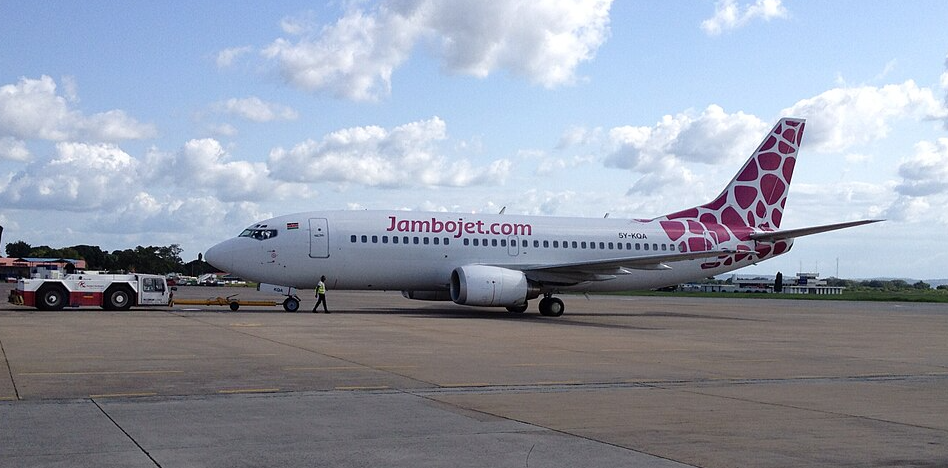
A man who tested positive for the Ebola virus flew into Nairobi on a Jambo Jet in early October and subsequently infected six others (Wikimedia Commons, bandabarn).

Kenya has confirmed seven Ebola cases as of October 17 as the ongoing outbreak in the Democratic Republic of the Congo (DRC) spills over national borders.
The Kenyan Ministry of Health announced the first case in a press statement on October 6. The infected man had entered the capital of Nairobi on October 3 before dying two days later. Since then, the Ministry of Health has detected six more cases, including three close family members of the deceased and three healthcare workers.
The Ebola virus, transmitted by bats and spread through contact with bodily fluids, has infected over 9,000 people and killed over 4,000 in the DRC. The outbreak also spread to Uganda, but there have been no reports of Ebola there since June. Ebola virus mimics a fever in its early stages before causing severe diarrhea, internal hemorrhaging, and/or organ failure.
The first Kenyan contracted Ebola more than a month before his death while in the DRC, where he had lived for seven years before falling ill and returning to his family in Nairobi. Since September, he had traveled to three different provinces in the DRC and had taken two flights into major cities Kisangani and Beni. He had then driven to Kampala, Uganda before flying into Jomo Kenyatta International Airport (JKIA) in Nairobi. He had returned home with family before being driven to the Nairobi hospital and isolated there. Despite visiting at least three different healthcare facilities in the DRC, the man was never tested for Ebola.
At least 23 passengers and four crew members were directly exposed during the flight, and the Ministry of Health has identified and quarantined more than 100 contacts from the first case. All subsequent cases have come into direct contact with the first case, and Dr. Patrick Amoth, Director General of Health, reassured the public in a press statement on October 14 that newly reported cases were already quarantined.
Aden Duale, the Cabinet Secretary of Health, urged calm in his press statement on October 6: “I wish to reiterate that we have continued to maintain a high level of alert for Ebola since the outbreak began in May 2026. As of 6th October 2026, we have screened 652,584 travellers. We have tested 267 samples… We have trained 4,971 health workers at both national and sub-national levels on Ebola prevention and management... I wish to reassure the public not to panic, as all systems are in place to mitigate the spread of the disease.”
Opposition parties have raised concerns about the government’s response and national preparedness. Following the initial press release, former Vice President and leader of the Wiper Democratic Movement Kalonzo Musyoka posted on X, “Kenyans deserve answers…. if the system was ready, why did screening not trigger further assessment?” He questioned how the individual passed through airport security and entered a private car without detection during airport health screenings. Former Attorney General and Democratic Party leader Justin Muturi echoed these statements, telling The Eastleigh Voice, “Preparedness cannot be measured by press conferences and budget announcements; it must be measured by what happens when the first suspected case actually arrives.”
John Kraemer, an epidemiologist and associate professor at Georgetown University who worked in Liberia in the West Africa Ebola outbreak in 2014-2016, told The Caravel, “There is a lot we don’t know yet about the man who traveled to Kenya with Ebola… it’s hard to know what broke down between diagnosis, isolation, and airport departure and arrival screening.”
Kenyans have had diverging reactions. Some expressed fear, with Reddit user Joan Carol Clayton posting, “We’re screwed.” Notably, some youth are worried about government crackdowns on free assembly and other freedoms, with several Facebook users mentioning the possibility of lockdowns. Reddit user Asaph-Suleiman wrote, “If we have another lockdown, we are done as a country. Kasongo Mefi [a pejorative term used by Gen Z protestors for President William Ruto] will use it as an excuse for crackdowns and avoiding elections.” Meanwhile, some Kenyans do not believe the news, viewing it instead as a ploy of Ruto’s government in order to obtain international funds. Reddit user Agreeable_Aerie_360 wrote, “I don't trust this. The current govt can cook absolutely anything for money especially in the season we're in,” and user La_joya021 echoed, “Somebody is definitely waiting for the numbers to go up aende kukopa pesa ya kucontain [to go borrow money to contain] the disease.” Following reports of more cases, Facebook user Kamau SK posted, “Numbers are rising very fast, or made to rise very fast?” The skeptical comments may reflect unrest over the rising cost of living and public debt in Kenya or express frustration over recent state violence towards protestors.
Professor Kraemer doesn’t foresee a massive outbreak: “Kenya seems to have identified him quickly and has a very capable public health system, so I don’t think there is a serious danger of widespread transmission, though it is entirely possible that his family members or very close contacts while traveling could, tragically, acquire the disease.”
Kenya remains open right now, with no restrictions on travel, trade, or public gatherings.