
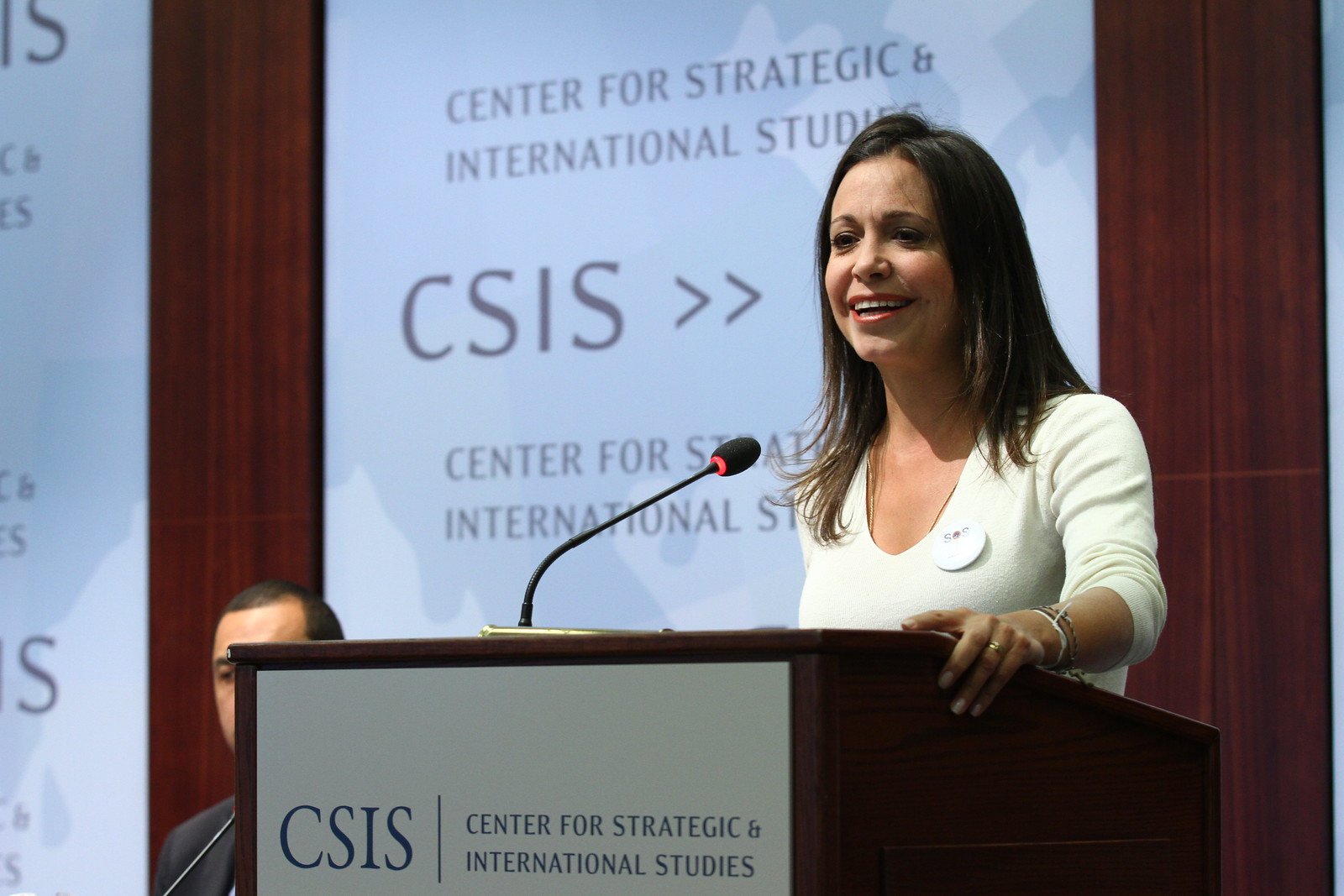
Ms. Machado speaks at an event in Washington, D.C. (Flickr)
The Norwegian Nobel Committee awarded the Nobel Peace Prize for 2025 to Maria Corina Machado on October 10. Ms. Machado, the leader of Venezuela’s opposition party, was recognized “for her tireless work promoting democratic rights for the people of Venezuela and for her struggle to achieve a just and peaceful transition from dictatorship to democracy,” according to the Nobel Committee’s announcement.
Ms. Machado, known as the Iron Lady of Venezuela, is the forceful presence behind the opposition to President Nicolás Maduro, whose crackdown on electoral rights, freedom of expression, and dissidents has been widely reported, including by the New York Times. Ms. Machado is a “unifying figure” in opposition to President Maduro’s rule in Venezuela, where she has advocated for fair elections for decades and is working for “the freedom of the Venezuelan people,” writes the Nobel Committee.
While the Committee’s decision highlights the work of a brave individual, much of their announcement concentrates on the importance of fighting for democracy in a time where “fewer and fewer [elections] are free and fair.”
“Democracy is a precondition for lasting peace. However, we live in a world where democracy is in retreat, where more and more authoritarian regimes are challenging norms and resorting to violence,” states the Norwegian committee’s announcement.
In a world such as this, where authoritarian regimes are winning and norms are eroding, does the Nobel Peace Prize still matter?
Much has been written and studied about the “False Promise” of the Nobel Peace Prize. Krebs (2009), for example, analyzes the “unexpected and unwanted outcomes” of the prize, from increased state repression to failing to affect lasting political change.
Not just in academic literature, but also in popular discourse, there is a recognition that the Nobel Peace Prize has become increasingly reflective of political objectives. Krebs (2009) writes that “The more aspirational the Prize, the more clearly the Committee has tried to use it for political effect,” observing that this is an admitted goal of the Nobel Committee. One notable example is President Obama’s win in 2009, considered a “rejection of the unpopular tenure” of President Bush that “elicited praise and puzzlement around the globe,” wrote the New York Times.
While winning a Nobel can bring attention to an important cause, drawing the world’s attention to one person and one movement can often result in increased state anxiety and violence. Iranian awardee Shirin Ebadi faced rising numbers of death threats after she won the prize in 2003 and the regime’s human rights record continued to deteriorate, as reported by the BBC. Moreover, positive attitude shifts to the awardee’s cause are short-lived, as seen in regards to support for women’s organizations following the awarding of the prize, according to Kikuta and Hanayama (2024).
Immediately after the Committee announced Ms. Machado’s win, White House communications director Steven Cheung stated that the Nobel Committee had placed “politics over peace” in failing to select President Trump for the award, as reported by the Hill. President Trump had been openly campaigning for the award, with support coming from leaders around the world who sought to “advance diplomatic interests” by encouraging his efforts, writes the BBC.
These facts tell a compelling story: the Nobel Peace Prize’s impact is diluted by the political machinations that determine its chosen laureate and the lack of tangible effects it has for the movement it honors. Furthermore, wars around the world—including, but not limited to, Ukraine, Gaza, Sudan, the Democratic Republic of the Congo, Yemen, and Syria—continue to take millions of lives and displace millions more people, all while failing to draw widespread international responses. Leaders around the world are adopting increasingly hawkish positions on national security, perhaps most clearly illustrated by the United States’s decision to rename the Department of Defense to the Department of War, as reported by NPR. Instead of a grave evil, war seems to have become inevitable—tragic but unavoidable, inescapable, and horrifyingly normal.
Yet, even in this world of war, the allure of the Nobel Peace Prize remains.
Celebrations of Ms. Machado’s victory have been muted—not due to a lack of support for her movement, but because Venezuelans fear repression from the state, states the New York Times. Ms. Machado remains in hiding, as President Maduro continues to quell opposition to his regime, attempting to diminish the value of her victory. Speculation abounds that the Nobel Committee’s decision was at least in part influenced by growing tensions between the United States and Venezuela, as reported by the Washington Post. Here, Nobel laureate status has at least a perceived ability to not only drive political decision-making, but to threaten the stability of regimes.
President Trump and his supporters were quick to express their belief that he should have received the award. In an event on October 10, the President stated that Ms. Machado had called him after the announcement saying that she accepted the award “in his honor,” writes the Washington Post. President Trump also expressed his support for Ms. Machado, after “helping her along the way,” reports the Washington Post.
With President Maduro’s limits on celebrations within Venezuela and President Trump’s disappointment in not being personally recognized by the Nobel Committee, it is evident that even these combative leaders recognize the importance of this honor. But with empirical evidence suggesting that Nobel recognition does not necessarily drive permanent change, there must be another reason to fight for the Peace Prize.
Wendt (1992) writes that states’ identities, and their perception of their own identities, can be used to explain state behavior. His theory, known in the field of international relations as Constructivism, suggests that while material power in and of itself may affect how states interact in the international system, what really matters is how states perceive themselves and how states perceive others.
The Nobel Peace Prize remains important even in this era of war because of its ability to define state identity. It identifies movements as objectively good or moral, while resigning others to malfeasance. States who lose out on Nobel recognition must wrestle with the cognitive dissonance that results from supporting a regime that has been typified as antithetical to peace. While war is normalized, peace is still something to fight for.
This, perhaps, is the Nobel’s true power. In their various reactions to the Committee’s decision, authoritarian leaders from President Trump to Prime Minister Netanyahu confirm that peace is still a powerful currency in the reshaped international arena. Despite the wars that consume international relations, peace is still a valuable identity-generating norm. States and their regimes continue to strive to be identified with the immense moral weight generated by the Nobel Peace Prize. Justification for political objectives remains a critical goal of regimes, even undemocratic ones.
In the phone call that announced her victory, Ms. Machado identified why exactly the Nobel Peace Prize still matters in a war-filled world.
“I hope you understand this is a movement, this is an achievement for a whole society,” she said, as reported by the New York Times. The Nobel gives not only recognition but legitimacy, as it creates a credible identity that has the power to redefine how campaigns, regimes, and even individuals are perceived on the world stage.
Josephine Balistreri (SFS ‘26) is the Opinion Editor at the Caravel. The views expressed in this article belong solely to the author.