
The Debate Behind UN Reform: Calls for Two Permanent Seats for Africa
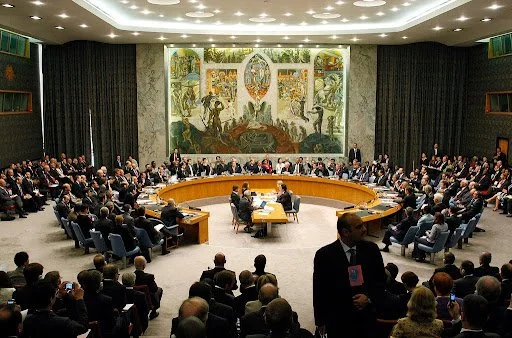
The five permanent members of the UNSC convene while the General Assembly watches (Flickr).
UN Secretary-General Antonio Guterres reignited a debate on the UN Security Council after calling for UN reform during a speech on October 21.
Guterres advocated for two additional permanent seats for African countries, explaining that permanent African members would aid the fight against climate change and poverty. In his speech, he stated, “We can only move forward if we also renew and update global institutions, by making them more effective, fair and inclusive.” These remarks follow the UN’s adoption of the Pact of the Future, which prioritizes African security challenges.
Since its founding in 1945, there have been five permanent members on the UN Security Council (UNSC): the United States, France, the United Kingdom, China, and Russia. There are also ten rotating members that change every two years. Permanent members get ultimate veto power. The UNSC only ever added one new permanent member with the substitution of Taiwan with China in 1971. Adding two new seats would be revolutionary, requiring at least two-thirds of the General Assembly vote—including all five permanent UNSC members—to pass. Author of UN Peacekeeping in Civil Wars and former Director of UN Affairs in New York Lise Howard doubts its chances: “Negotiations about UNSC reform have been going on since I was working at the UN in the early 1990s, so I’m not holding my breath!”
For nearly two decades, African countries have campaigned for reform of the UNSC. Even though the UNSC reserves only three impermanent seats for over 50 African countries, over half of its meetings and 70 percent of UN resolutions concern African security challenges. To advocate for themselves, African countries formed the C-10 in 2005. Together with the African Union (AU), they passed the Ezulwini and Sirte Declarations, which created a unified platform on how African countries want the UNSC to address HIV/AIDS, poverty, and UN Peacekeeping. Most importantly, these two documents were the first to point out the need for permanent African seats on the UNSC.
Which African countries would have two permanent seats is still unclear. The Atlantic Council floated the idea of choosing members based on economic resources, population, or security challenges, suggesting South Africa, Egypt, Nigeria, and the DRC as viable candidates. Georgetown Professor of African Political Economy Ken Opalo reasons, “As one can imagine, it will be a thorny question regarding which country gets selected. The AU has a political culture of governing through the principles of equality and consensus, which might be upset by an open acknowledgement that there are some countries (e.g. South Africa and Nigeria) that are stronger than others. However, I believe that the region would be best served by ensuring that real hegemons (Nigeria and South Africa) take the seats, rather than weaker countries that lack the ability to project power within the region and beyond.”
While some members of the UNSC declared their support for permanent African seats, none have taken definite steps toward reform. China and Russia have broadly supported Africa’s bid, but neither has officially validated the Ezulwini or Sirte Declarations. The United States, the United Kingdom, and France expressed their support for additional seats but have refused to extend veto power. In any case, none of the five permanent members are rushing to make reforms. In the past, they’ve expressed support for permanent seats for Latin America and Asia, yet these reforms never materialized. It seems that these recent promises will also fall short. Dr. Opalo explains, “The U.S. move to support Africa's bid at this time is decidedly political and (cynically) driven by the fact that the U.S. knows it won't materialize. All P5 members stand to lose influence in an expanded UNSC, so they have real incentives to keep it small.”
That said, some countries have overtly opposed African permanent seats. The United for Consensus Group (UfC), which includes Canada, Colombia, Italy, and Pakistan, argue that creating permanent seats for some countries over others would create irreparable divisions within the UN. When proposing his own reforms for the UN in 2005, Canadian representative Allan Rock warned, “Widening the permanent circle for the few who sought special status, no matter how worthy their candidacies, would make the Council less accountable for its conduct, more remote from the membership and less representative of the world’s regions.” Instead, the UfC proposes an expansion of the non-permanent members to 20, including six African countries.
Africa’s fight to reform the UNSC brings up other questions about the very structure of the UN and global governance. Other countries have also requested permanent seats, notably Brazil, Germany, India, and Japan (known as the G4). With over 195 UN members, the UNSC cannot include every country or pass enough peacekeeping mandates to address food insecurity, poverty, or civil conflicts in each one. Meanwhile, the current Council’s increasing geopolitical rivalries prevent its members from uniting on global security challenges, let alone reform. As debate over new seats heats up, some experts wonder if Africa should even attempt to change the UNSC at all. They argue that new seats would legitimize an institution that has failed to address the world’s most pressing challenges for decades.