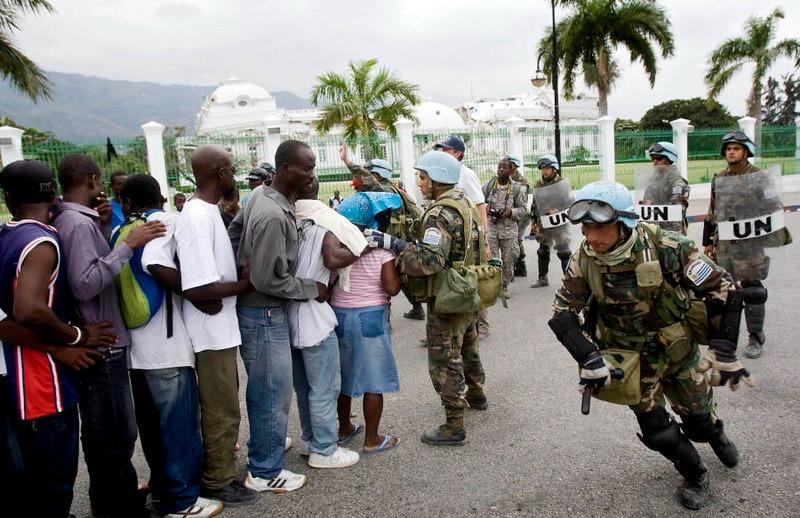
Following an ambush on four Salvadoran personnel in Haiti on October 18, President of El Salvador Nayib Bukele has deployed nearly 2,000 soldiers to the island to support ongoing search and rescue operations.
In the ambush, a gang attacked the armored vehicle of four Salvadoran aviation technicians in Croix-des-Bouquets, a Port-au-Prince commune. The aviation technicians were members of the Gang Suppression Force (GSF), a UN mission that began operations in September 2025 to combat escalating armed gang violence in Haiti, according to a report by the group.
The deployment of troops represents Bukele’s first test abroad of the hardline anti-gang strategy that he has pursued domestically in El Salvador since March 2022, according to The New York Times’ The Daily podcast. This brutal crackdown, through mass arrests and military operations, has slashed homicides and dismantled gangs, but has sparked major human rights concerns. Similarly, the Salvadoran troop deployment in Haiti has received criticism from human rights groups for operating outside of the GSF’s legal framework for operations in Haiti. The massive Salvadoran operation in Haiti, whose numbers match the current deployment of the GSF, has been accused of conducting “aerial bombardments, helicopter gun attacks, and heavy weapons assaults in civilian neighborhoods,” per LatinNews.
LatinNews reports that President Donald Trump, a key ally of Bukele’s, spoke with him on October 31, during which Bukele told him that “he had a big problem with Haiti… they killed some of his people.” Trump then told Bukele: “You’re running your country. You have to do what you have to do.” According to a US military official, the US provided C-130 transport aircraft to help move Salvadoran troops to Haiti.
The Trump administration has leveraged close ties with El Salvador in the past when it paid El Salvador to house deported immigrants from the US in its prisons, according to KQED. Trump’s apparent backing of the Salvadoran troops in Haiti has sparked speculation that Washington is merely using El Salvador as a security intervention to validate Trump’s prior remarks that conditions in Haiti are sufficiently safe to allow for the return of Haitian immigrants deported by the Trump administration.
So far, the massive Salvadoran troop deployment has pressured one of Haiti’s most prominent gang leaders, Wilson Joseph, alias “Lanmò San Jou,” to send a letter addressed to the United Nations (UN) Secretary-General asking them to send a delegation to facilitate dialogue in Haiti. According to AP News, in the letter, Joseph also warned that the Salvadoran troop deployment could further escalate violence.
At the time of writing, the most recent development in the situation occurred on November 11, when the Salvadoran troops destroyed the two-story estate of Lanmò San Jou and the headquarters for 400 Mawozo, one of Haiti’s largest crime gangs, according to The Telegraph.
The large-scale deployment of Salvadoran troops has proven more effective than the GSF at controlling Haiti’s security crisis. It remains to be seen whether Bukele will scale up the operation by sending in more troops and thus outnumbering the UN peacekeeping mission, or withdraw forces from the island.