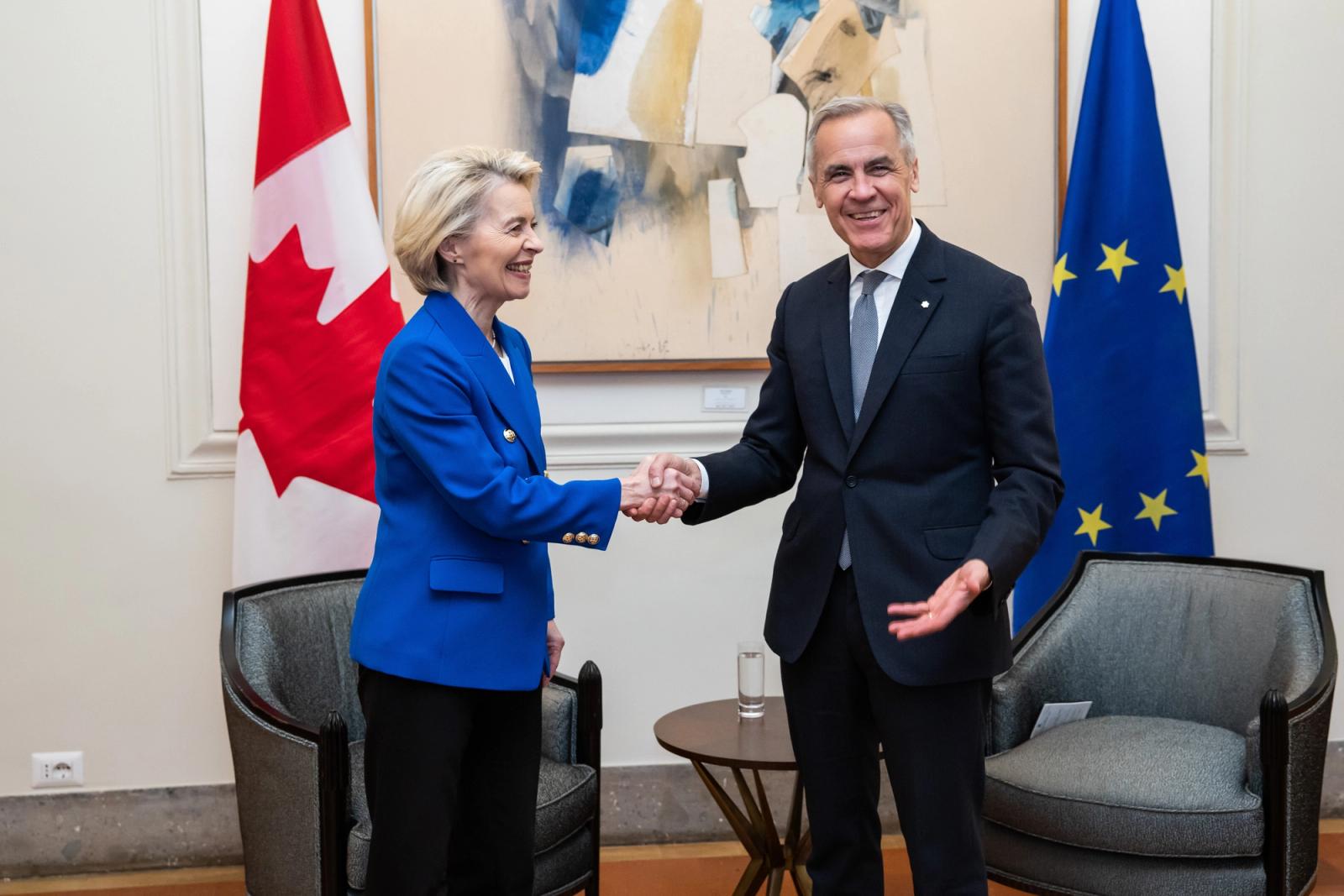
European Commission President Ursula von der Leyen proposed making Canada the European Union’s (EU) first associate member during her annual State of the Union address in Strasbourg on September 16. The unprecedented arrangement promises to deepen technological, defense, and economic ties between the two partners. Canadian Prime Minister Mark Carney welcomed the proposal for closer cooperation at the European Parliament the following day, amid growing geopolitical and economic uncertainty.
The proposal builds on a growing bilateral relationship. Global Affairs Canada points to two agreements that form the foundation of current EU-Canada relations. First, the Comprehensive Economic and Trade Agreement (CETA), lauded by Carney as “one of the world’s most successful trade agreements,” deepened economic ties between the two parties after being signed in 2016. Second, the Strategic Partnership Agreement (SPA), signed at the same time, established a framework for political, foreign policy, and security relationships. While these agreements laid the groundwork for increased cooperation, the recent deterioration of Canada’s relations with the United States has emphasized the strategic importance of its ties with the EU.
As reported by the New York Times, trade talks between Canada and the United States collapsed on August 21, “locking the two countries in an intensified trade war.” President Donald Trump has also “repeatedly called for Canada to become the 51st state.” The deterioration of US-Canada relations is substantially reflected in Canadian public opinion. According to Abacus Data’s poll results released in September of this year, only 21% of respondents held generally positive impressions of the United States, a stark contrast to attitudes toward the EU, where 74% held positive impressions of the European Union. According to the same source, “over half (58%) of all Canadians agree that Canada has more in common with countries of the European Union than with the United States.” The poll finds that Canadians found broad support for increased European integration: 81% of respondents support closer Canada-EU integration. Canadian public opinion and political leadership thus appear broadly aligned, strengthening ties between the two parties. However, it is unclear what this would look like, and what the newly proposed associate membership would entail.
Legal restrictions, such as Article 49 of the Treaty on European Union, outline that only “European” states can acquire membership; thus, Canada and other non-European states are unable to become full members of the Union. Von der Leyen, during the State of the Union address, mentioned that Canada and the EU “will move from CETA to an Alliance for the Future to create a common prosperity and economic security space.” She proposed integrating defense industrial bases, “making the Arctic a flagship joint project,” and expanding cooperation on energy, artificial intelligence, cybersecurity, and economic security. Summarizing these ambitions, von Der Leyen stated, “In short, we [the European Union] want to bring the relationship with Canada to the highest level possible.”
These ambitions have not been without political friction, however. During her address, von der Leyen clarified that “this is a partnership not against anyone else, but for our common strength.” Although she did not explicitly mention the United States, President Donald Trump interpreted the proposal differently. When asked about Canada’s potential new associate membership in the EU on September 16, Trump referred to it as “laughable,” adding that “if they [the EU and Canada] do that, and I think at all that it’s a hostile act, I will put very serious tariffs or stop trading with Europe on many things.” Trump’s response underscores how the United States’ relations with Canada and the EU have greatly deteriorated, raising questions about how Canada’s potential associate membership in the EU could further strain relations with Washington.
Canada’s potential associate membership within the European Union remains a proposal, but the upcoming EU-Canada Summit in Montréal on October 29-30 is expected to provide greater clarity on its future. Whatever the outcome, von der Leyen’s proposal marks a significant development in EU-Canada relations, with implications extending well beyond Brussels and Ottawa.