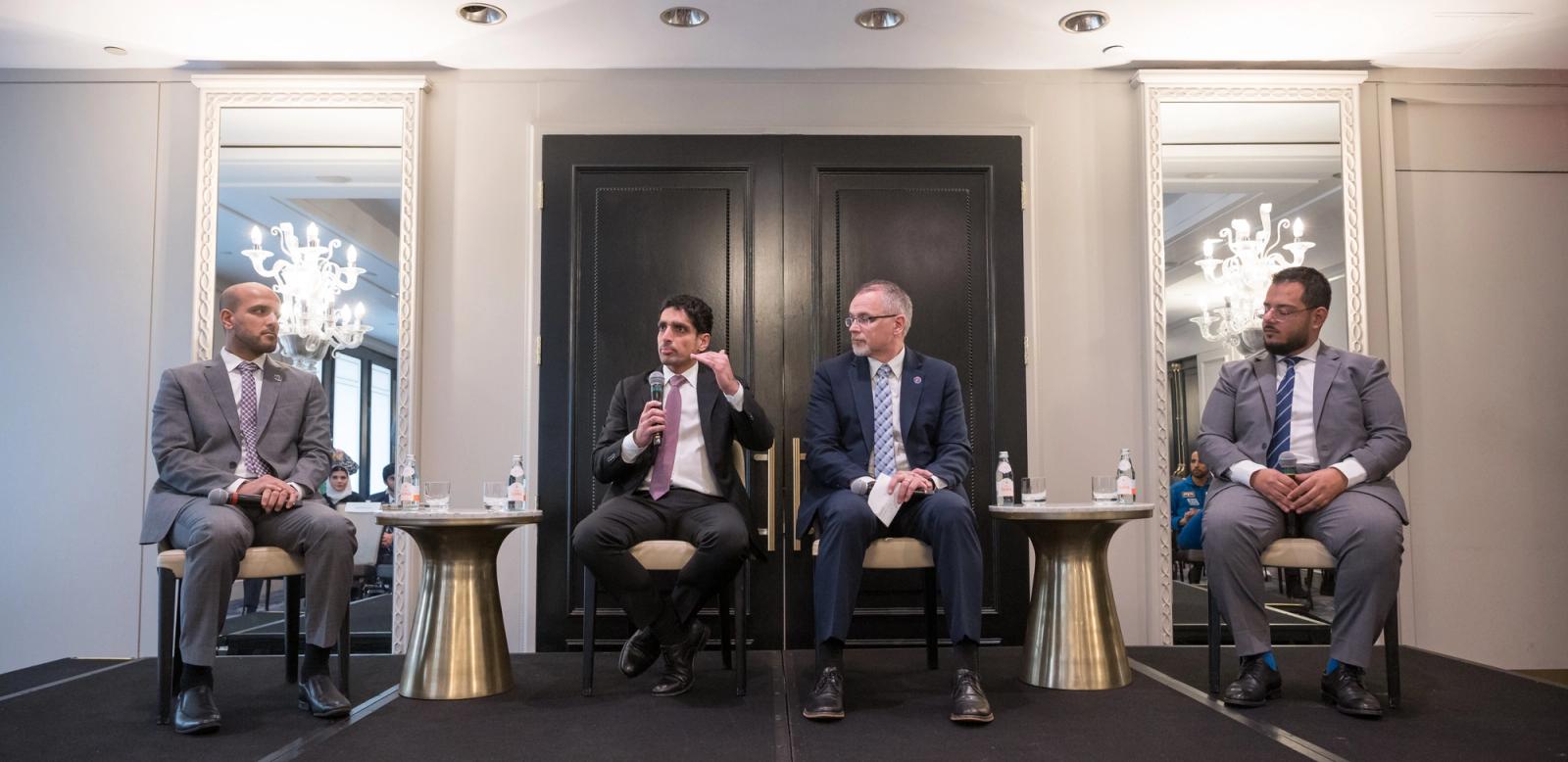
The United Arab Emirates and the United States deepened their technology, space, and Research and Development cooperation through multiple high-level meetings on October 3. The UAE delegation met with U.S. officials at government agencies and academic institutions to advance cooperation in artificial intelligence, cybersecurity, space, and quantum computing.
These engagements build on previous work to transform the U.S.-UAE relationship from a traditional oil-and-security partnership to a more technology-focused partnership. The UAE and other Gulf states have recently invested heavily in AI research and development, with the UAE being classified as an “AI contender” by the Boston Consulting Group, according to Arab News. Still, the UAE needs American semiconductor chips, cloud computing, and companies that can operate AI systems.
This demand created room for further cooperation between the United States and the UAE. As reported by CNBC, in March 2025, the UAE committed to a ten-year, $1.4 trillion investment framework in the United States, promising to increase existing investment in U.S. AI infrastructure, energy, semiconductors, and manufacturing. The United States, in turn, benefits from the UAE building and operating a part of the world’s AI infrastructure. According to the UAE Ministry of Foreign Affairs (MOFA), in July 2026, the U.S. Department of Commerce announced that it is upgrading the UAE’s export control designation from D:3 to A:5, significantly removing restrictions on technology exports and streamlining access for approved UAE entities.
The meetings that occurred during the first week of October were a culmination of a years-long effort by the UAE to broaden U.S.-UAE technology cooperation.
Omran Sharaf, the UAE Assistant Foreign Minister for Advanced Science and Technology Affairs, led the UAE delegation, which included Dr. Mohamed Al Kuwaiti, Head of Cyber Security for the UAE Government, and senior representatives from the Advanced Technology Research Council (ATRC), the UAE Space Agency, and Space42. The delegation met with U.S. officials at the State Department, the Department of Commerce, the White House, and other industry and academic institutions, including the Hudson Institute and Johns Hopkins School of Advanced International Studies (SAIS).
According to a report by MOFA, Assistant Foreign Minister Sharaf said, "The UAE-US partnership is built on more than five decades of trust across the most sensitive sectors — defense, intelligence and nuclear energy. That same standard defines our approach to AI and advanced technology. Our investment, our infrastructure, and our institutions are built around this partnership, and this week's conversations reflect exactly that commitment.”
These meetings reflect how artificial intelligence is reshaping the U.S.-UAE relationship. The UAE needs access to advanced American technology to achieve its goal of becoming a global AI hub, while the United States wants to ensure that the UAE's growing technology sector remains closely connected to the U.S. rather than China. So, this partnership has implications not only for the UAE's economy, but also for U.S.-China technological competition and America's broader relationship with the Gulf. The growth of AI development has opened a new front in international affairs, as the Gulf States are no longer purely defined by security and oil concerns but now by technological opportunities as well.